Introduction
As factories evolve toward full automation and digital transformation, every component inside an industrial system plays a critical role in safety, efficiency, and operational reliability. While advanced PLCs, sensors, and robotic systems often receive the spotlight, one device remains surprisingly indispensable: the two way push button.
Compact, durable, and highly functional, two way push buttons continue to serve as a fundamental interface between humans and machines—even in today’s era of smart manufacturing. This article explains why these dual-function control switches are essential in modern automation environments.
 What Is a Two Way Push Button?
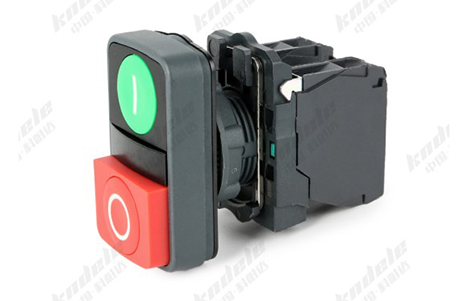
A two way push button is a control switch that integrates two related operations in one device—for example:
Forward / Reverse
Up / Down
Start / Stop
Open / Close
It typically combines NO (Normally Open) and NC (Normally Closed) contact blocks, allowing operators to control paired functions quickly and efficiently.
Why Two Way Push Buttons Are Essential in Modern Automation
Human–Machine Interaction Remains Crucial
Even in fully automated production lines, operators still need a way to:
Start or stop processes
Adjust machine directions
Override automated sequences
Perform calibration and maintenance
Two way push buttons provide a simple, intuitive, and reliable control method, giving workers direct interaction with machines without navigating complicated digital interfaces.
Dual-Function Control Saves Panel Space
Smart manufacturing systems pack numerous devices into compact control enclosures. Two way push buttons help:
Reduce panel size
Minimize wiring
Simplify layout design
Lower assembly time and cost
Combining two functions in one device makes it ideal for space-conscious automation equipment.
Enhanced Safety Through Clear, Direct Operation
In fast-paced production environments, safety is non-negotiable. Two way push buttons improve operator safety by offering:
Clear directional labeling (arrows/colors)
Distinct tactile feedback
Separation of opposite functions
Instant manual shutdown options
When automated systems fail or require manual intervention, operators need a dependable physical device—and two way push buttons deliver exactly that.
Highly Reliable in Harsh Industrial Environments
Smart manufacturing often involves environments with:
Dust
Moisture
Vibration
High temperatures
Continuous operation
Industrial-grade two way push buttons are engineered with:
High mechanical lifespan
IP-rated protection
Rugged, wear-resistant materials
Stable contact performance
This durability ensures that critical controls remain functional under challenging conditions.
Ideal for Motor, Conveyor, and Motion Control
Modern automation heavily relies on motion systems. Two way push buttons are essential for manual control of:
Conveyor direction
Motor forward/reverse
Hoist up/down
Actuator extend/retract
Doors and shutters open/close
Even with advanced automation, technicians often need manual controls for setup, troubleshooting, or safety checks.
Supports Both Manual and Semi-Automatic Systems
Smart factories increasingly combine automated processes with operator oversight. Two way push buttons enable systems to operate in:
Manual mode — for calibration, alignment, testing
Semi-automatic mode — for processes requiring occasional human input
Emergency override — for safety situations
This flexibility makes them a core component in hybrid automation setups.
Cost-Effective and Easy to Integrate
Compared to touchscreen interfaces or complex control systems, two way push buttons are:
Affordable
Quick to install
Easy to replace
Compatible with PLCs, relays, and motor control circuits
Their simplicity lowers both installation and long-term maintenance costs—an advantage for manufacturers seeking to optimize operational expenses.
Conclusion
In the era of Industry 4.0, two way push buttons may seem simple, but their importance cannot be underestimated. They provide safe, reliable, and intuitive control in modern automated environments—bridging the gap between human operators and advanced machines.
From conveyors and motors to smart production lines, these compact switches continue to be essential in ensuring efficiency, precision, and safety.
FAQ
What makes two way push buttons essential in modern automation?
Two way push buttons provide dual-function control in a compact device, allowing operators to manage tasks like Forward/Reverse, Start/Stop, or Up/Down. They ensure safety, reliability, and manual intervention capability even in automated systems.
Can two way push buttons work with automated systems?
Yes. They are fully compatible with PLCs, relays, motor starters, and automation controllers, making them suitable for both manual and semi-automatic operations.
Are two way push buttons safe for industrial use?
Absolutely. Industrial-grade models have:
IP-rated protection against dust and moisture
Durable, wear-resistant materials
Clear labeling and tactile feedback
These features reduce the risk of operator error and enhance safety.
Where are two way push buttons commonly used?
Typical applications include:
Conveyor direction control
Motor forward/reverse operations
Hoists and lifts up/down control
Actuators and industrial doors
Emergency stop or manual override in automated lines
Can they operate in harsh industrial environments?
Yes. They are designed to withstand:
Vibration and mechanical stress
High or low temperatures
Continuous operation
Dust and moisture exposure
This durability ensures long-term performance in demanding manufacturing settings.
Do two way push buttons save control panel space?
Yes. By integrating two functions into one device, they reduce the number of switches and wires required, making panels more compact, organized, and cost-effective.
Are two way push buttons easy to install and maintain?
Yes. They are affordable, easy to mount, and compatible with standard industrial wiring practices. Replacement or maintenance is quick, minimizing downtime.