


In modern industry, reliability and safety often depend on one small component—the push button switch. From motor starters to emergency stops, these devices are the interface between human operators and powerful electrical systems.
Unlike many general online guides, this article is written from an electrical switch engineer’s perspective. We’ll explain not only the different types of push button switches, but also their construction, standards, applications, and selection criteria. By the end, you’ll have a clear understanding of which push button switch types are best suited for your industrial projects.

An industrial push button switch is more than just a plastic button—it is a carefully engineered control device designed to operate in demanding environments such as factories, power plants, and utility substations.
Mechanical Design:
The actuator (button cap) may be flat for anti-accidental operation or extended for use with gloves.
Inside, a spring mechanism provides tactile feedback, ensuring operators can feel when the circuit has been engaged.
Electrical Contacts:
NO (Normally Open): Circuit completes only when pressed—ideal for starting motors or sending a signal.
NC (Normally Closed): Circuit opens when pressed—commonly used for stop or emergency functions.
Contacts are usually made from silver alloy to handle arcing and high current loads.
Durability:
Industrial push buttons are designed for millions of cycles, unlike consumer switches that may fail after a few thousand uses.
Mechanical life: 3–5 million actuations.
Electrical life: often 0.5–1 million operations depending on load.
Environmental Protection:
IP65 / IP67 enclosures protect against dust, oil, and water, making them suitable for harsh production lines.
Some models are also IK-rated for impact resistance.
Compliance Standards:
IEC 60947-5-1 – General requirements for control circuit switches.
IEC 60947-5-5 – Emergency stop requirements.
UL, CE, CCC – Regional certifications ensuring safety and reliability.
In short: an industrial push button switch is not just a switch—it is a safety-certified interface designed to ensure safe, reliable, and repeatable machine operation.
(For a deeper look at real-world uses, see our related article on push button switch applications).

Push button switches can be classified by operation mode, function, and structural design. Let’s explore each type in detail.
How it works: Returns to its normal state once released.
Use case: Often used for start signals in motor control, or as an input in automation panels.
Engineering detail: Provides tactile feedback, ensuring reliable operator response. Can be NO or NC depending on circuit design.
Example: Green “Start” button on a conveyor system.

How it works: Stays in position after being pressed, until pressed again.
Use case: Ideal for ON/OFF power circuits, mode selection, or lighting systems.
Engineering detail: Commonly used with dual contact blocks to handle both control signals and power isolation.
Example: Power switch for industrial lighting panels.
Description: Usually paired—Green for Start (NO) and Red for Stop (NC).
Application: Standard in motor starters, control panels, and production line stations.
Engineer’s note: Using separate colors improves operator safety and reduces human error.
Description: Large mushroom-shaped red button; once pressed, it locks in position and requires a twist or pull to release.
Standard compliance: Must meet IEC 60947-5-5.
Application: Used on machines where immediate shutdown is critical, such as presses, CNC machines, and conveyor systems.
Engineer’s note: Always wired with NC contacts to ensure fail-safe operation.

Description: Include integrated LED lights to indicate machine status (green = running, red = fault, amber = standby).
Application: Common in process control panels.
Engineer’s note: Improves usability in noisy environments where audible alarms may not be heard.

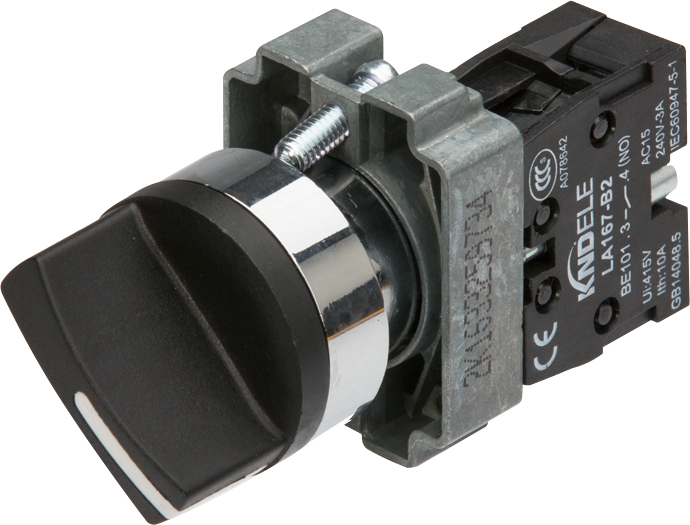
Description: Rotary style button with multiple positions (e.g., Manual / Auto / Remote).
Application: Used in industrial automation to switch between control modes.
Engineer’s note: Reduces panel space compared to multiple individual buttons.
Description: Two actuators stacked in one housing (Start/Stop).
Application: Compact solution for machine control stations.
Engineer’s note: Saves space and simplifies wiring for operators.

Description: Operated with a key to prevent unauthorized use.
Application: Found in elevators, cranes, and restricted access systems.
Engineer’s note: Often combined with maintained contacts for security-critical systems.
Advantage: Reduced risk of accidental operation.
Application: High-traffic panels in public or industrial areas.
Advantage: Easier to press when wearing gloves.
Application: Heavy industry, cold storage facilities.
Advantage: IP65–IP67 rated, resistant to water jets, oil, and dust.
Application: Food processing, outdoor equipment, marine applications.
Advantage: Built to ATEX / IECEx standards, prevents sparks from igniting flammable gases.
Application: Oil & gas plants, chemical factories, mining operations.
Beyond the basics, engineers often compare push buttons using additional dimensions such as contact material, actuation force, and maintenance requirements.
| Type | Operation | Contacts | IP Rating | Standards | Durability | Applications |
|---|---|---|---|---|---|---|
| Momentary | Auto-reset | NO / NC | IP40–IP67 | IEC 60947-5-1 | 1–5 million cycles | Start signals, machine cycles |
| Maintained | Latching | NO / NC | IP40–IP67 | IEC 60947-5-1 | 1–3 million cycles | Power ON/OFF, lighting circuits |
| Emergency Stop | Push-lock | NC | IP65+ | IEC 60947-5-5 | 0.5–1 million cycles | Machine safety shutdowns |
| Illuminated | Both | NO / NC | IP40–IP65 | IEC / UL / CE | 0.5–2 million cycles | Status indication panels |
| Key-Operated | Maintained | NO / NC | IP40–IP67 | IEC / UL / CE | 1–3 million cycles | Access control, elevators, cranes |
| Explosion-Proof | Both | NO / NC | ATEX / IECEx | IECEx / ATEX | 0.5–2 million cycles | Oil, gas, mining, chemical plants |
Additional comparison factors:
Contact Material (silver alloy vs gold-plated for low current).
Actuation Force (light touch vs heavy-duty).
Mounting Method (panel-mount vs PCB-mount).
Serviceability (modular designs allow easy replacement of contact blocks).
Push button switches are found across nearly every industrial sector:

Power Distribution Panels
Used for circuit control, ON/OFF switching, and fault indication.
Keywords: electrical cabinets, control panels, low-voltage switchgear.
Industrial Machinery & Automation
Start/Stop controls for CNC machines, conveyor belts, packaging systems.
Emergency stops in compliance with IEC 60947 standards.
Keywords: machine safety, operator interface, automation systems.
Energy & Utilities
Used in substations and smart grid control systems.
Support remote/local mode switching with selector buttons.
Keywords: power distribution, grid automation, control circuits.
Elevators & Cranes
Key-operated switches for restricted control.
Emergency stop buttons for safety compliance.
Keywords: lift systems, hoisting control, operator safety.
Hazardous Environments
Explosion-proof models ensure safety in flammable areas.
Keywords: ATEX, IECEx, oil & gas safety, chemical plant control.
As an engineer or buyer, selecting the right switch isn’t just about price—it’s about performance, safety, and compliance. Here’s what to consider:
Define the Function
Start/Stop? Emergency stop? Mode selection? Each has unique requirements.
Match the Environment
Dusty, humid, outdoor, or explosive atmospheres demand higher IP or ATEX ratings.
Check Contact Ratings
Verify current/voltage compatibility (e.g., AC-15, DC-13 utilization categories).
Verify Standards Compliance
For critical safety, ensure compliance with IEC 60947-5-1 / 5-5, UL, or CE.
Evaluate Durability
Higher cycle ratings = lower long-term maintenance costs.
Consider Ergonomics & Safety
Flush buttons for anti-accidental use, extended for glove operation, mushroom for emergencies.
Think About Maintenance
Modular designs allow quick replacement of contact blocks without rewiring.
From years of sourcing experience, the most common mistake buyers make is overlooking compliance. A cheaper push button switch may look identical, but without IEC or UL certification, it can fail under load or during an emergency—putting safety and reputation at risk.

Industrial push button switches may be small, but they are the front line of machine safety and control. By understanding the different types of push button switches, their standards, and their real-world applications, engineers and buyers can make informed choices that ensure safety, reliability, and compliance.
When selecting your next push button switch type, don’t just look at cost—consider the environment, standards, and durability. That’s how you build a control system that lasts.


