


In industrial environments, safety is always a top priority. One of the most critical safety devices used in factories, warehouses, and machinery operations is the emergency push button. Understanding its function, types, and working principle is essential for ensuring workplace safety and compliance with industry standards.
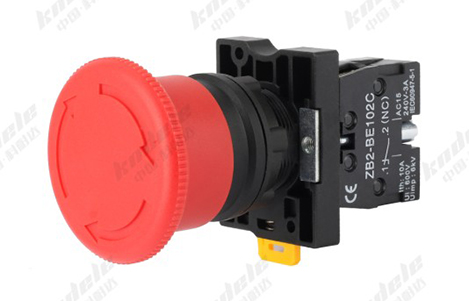 What Is an Emergency Push Button?
An emergency push button (also called an E-Stop) is a manually operated switch designed to immediately stop machinery or processes in case of an emergency. Its primary purpose is to protect personnel, equipment, and the environment from harm caused by unexpected situations, such as mechanical failures, electrical faults, or human error.
Emergency push buttons are widely used across industries including manufacturing, logistics, chemical plants, and energy production. They are often mounted in easily accessible locations so that anyone can quickly activate them in case of danger.
Mushroom-Shaped Head
The large, red, mushroom-shaped button ensures high visibility and easy activation, even in stressful situations.
Latch Mechanism
Most E-Stops use a latching mechanism, which means the button stays engaged until it is manually reset. This prevents accidental restart of machinery.
Normally Closed (NC) Contacts
Emergency push buttons typically use NC contacts. When the button is pressed, the circuit opens and immediately cuts off power to the connected equipment.
Compliance with Safety Standards
Emergency push buttons are designed to meet international safety standards, such as IEC 60947-5-1 and ISO 13850, ensuring reliable performance in critical situations.
The working principle of an emergency push button is simple but highly effective:
Activation
When a dangerous situation occurs, the operator presses the E-Stop. The button mechanically opens the normally closed circuit, cutting off power to the machinery or process.
Immediate Response
The machinery stops immediately, preventing potential injury, equipment damage, or environmental hazards.
Manual Reset
After the situation is under control, the E-Stop must be manually reset before the machinery can resume operation. This ensures that machinery does not restart unexpectedly.
Some modern emergency push buttons are integrated into smart control systems, allowing remote monitoring and logging of emergency events for maintenance and safety audits.
Standard Mushroom Head – Classic design, widely used in industrial machines.
Key Reset Emergency Push Button – Requires a key to reset, adding an extra layer of safety.
Wireless Emergency Push Button – Suitable for mobile machinery or remote areas.
Illuminated Emergency Push Button – Equipped with LED indicators for better visibility.
Emergency push buttons are used in a wide range of industries:
Manufacturing Plants – To stop assembly lines or robotic systems in case of malfunction.
Logistics and Warehouses – For conveyor belts and automated storage systems.
Chemical and Pharmaceutical Industry – To prevent spills or chemical hazards.
Energy and Utilities – For turbines, generators, and other high-risk equipment.
Enhanced Safety – Protects employees from accidents and injuries.
Equipment Protection – Prevents machinery damage during emergencies.
Regulatory Compliance – Meets international safety standards.
Ease of Use – Simple design ensures fast and intuitive operation.
Emergency push buttons are vital components in any industrial safety system. They provide a quick and effective way to stop machinery during emergencies, protecting both personnel and equipment. By understanding their types, working principles, and applications, industries can enhance safety measures and comply with international safety standards.
Q1: Can an emergency push button be used for all types of machinery?
A: While E-Stops are versatile, they must be selected according to the machinery type, voltage, and control system requirements.
Q2: How often should emergency push buttons be tested?
A: Regular testing, typically every 6–12 months, is recommended to ensure functionality and compliance with safety regulations.
Q3: What is the difference between a standard and a key reset E-Stop?
A: A standard E-Stop can be reset by twisting or pulling the button, while a key reset E-Stop requires a key, providing additional control over restart.
Q4: Are wireless emergency push buttons reliable?
A: Yes, wireless E-Stops are reliable if they meet industrial-grade standards and have a robust communication protocol. They are especially useful for mobile or large-area applications.

