


Push buttons with indicator lamps are essential components in industrial automation systems. They provide both control functionality and visual feedback, making them indispensable for operators and engineers who need reliable and immediate system status information.
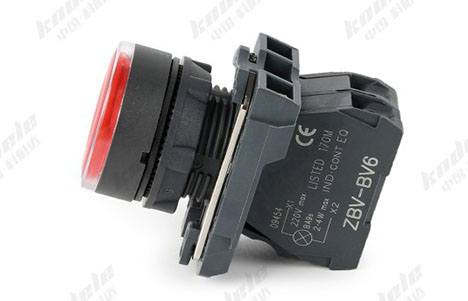 What Are Push Buttons with Indicator Lamps?
A push button with an indicator lamp is a switch that combines a standard push button with a visual signal. When pressed, the button sends a control signal, while the lamp lights up to indicate the status of the connected system, such as “ON,” “OFF,” or “fault.”
These devices are widely used in control panels, machinery, and industrial equipment, providing both operational control and instant feedback for safety and efficiency
Push buttons with indicator lamps are commonly used to start or stop industrial machines.
Example: Pressing a green push button starts a conveyor belt, while the lamp lights up to show the system is running.
This instant visual feedback helps operators avoid accidental machine activation or shutdown, improving safety and efficiency.
Control panels often use push buttons with lamps to indicate machine or system status:
Red Lamp: Fault or emergency stop condition.
Green Lamp: Normal operation.
Yellow/Amber Lamp: Warning or maintenance required.
This application allows operators to monitor multiple machines at a glance, reducing downtime and operational errors.
In industrial safety systems, push buttons with indicator lamps serve as emergency stop controls:
Pressing the button halts equipment immediately, while the lamp signals an emergency state.
This ensures rapid response in hazardous situations, protecting both personnel and machinery.
In automated production lines, push buttons with indicator lamps are used for process control and monitoring:
Operators can start, pause, or stop a specific production process.
Indicator lamps show machine readiness, process completion, or fault detection.
Common in packaging lines, robotic assembly, and CNC machining.
Push buttons with lamps are also used for resetting equipment or acknowledging alarms:
After a fault or error occurs, pressing the button resets the system, while the lamp provides confirmation of reset success.
This ensures smooth production continuity and prevents repeated errors.
Push buttons with indicator lamps can be integrated into PLC (Programmable Logic Controller) and SCADA systems:
Operators can interact directly with the machine interface.
The lamp’s status is often linked to real-time process variables, allowing quick diagnosis and control.
Visual Feedback: Immediate indication of machine status.
Enhanced Safety: Reduces human error and prevents accidents.
Operational Efficiency: Streamlines control of complex machinery.
Versatility: Suitable for various voltage levels, mounting types, and industrial environments.
Durability: Designed to withstand harsh industrial conditions, including dust, moisture, and vibration.
Push buttons with indicator lamps play a crucial role in industrial automation, offering both control and feedback in one compact device. From starting machinery to signaling faults and integrating with advanced control systems, these components enhance safety, efficiency, and reliability across industrial operations.
Investing in high-quality push buttons with indicator lamps ensures smooth operation, reduces downtime, and provides clear visual feedback, making them a must-have for modern automated facilities.
Q1: Can push buttons with indicator lamps be used in hazardous environments?
Yes, industrial-grade models with proper IP ratings and certifications are designed for dust, water, and explosion-prone environments.
Q2: What colors of indicator lamps are typically used in industrial automation?
Red: Emergency or fault
Green: Normal operation
Yellow/Amber: Warning or maintenance
Blue/White: Special functions or auxiliary signals
Q3: Are LED lamps better than incandescent lamps in push buttons?
Yes, LEDs are more energy-efficient, durable, and long-lasting, making them ideal for continuous industrial operation.

